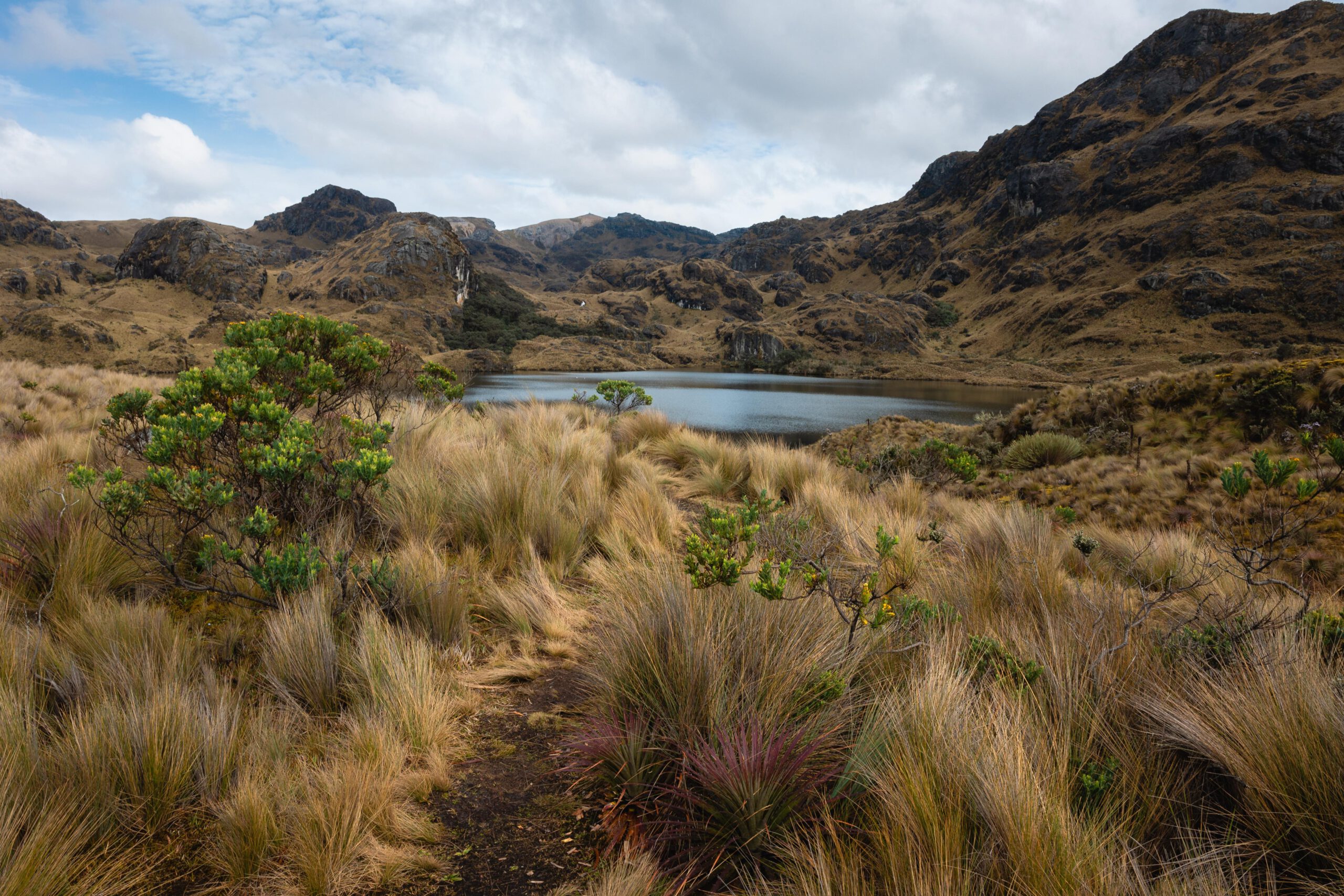
Im Fachblatt „Organic Geochemistry“ erschien ein Paper von Sae-Lim et al. zur Temperaturentwicklung in den peruanischen Anden während der vergangenen 2700 Jahre. Die Temperaturrekonstruktion basiert auf Biomarker-Methoden eines Sedimentkerns aus einem See. Im Zuge der Mittelalterlichen Wärmeperiode erhöhte sich die Lufttemperatur um 2,0°C und die Oberflächentemperatur des Seespiegels um 0,9°C. Zwischen 1300-1700 kühlte sich die Luft um 0,3°C und das Oberflächenwasser um 1,0°C ab, eine Abkühlung im Zuge der Kleinen Eiszeit. Ein Minimum wurde in den späten 1970er Jahren erreicht. Seitdem hat sich die Oberflächentemperatur des Sees um 1,7°C erwärmt. Dies ist die Wiedererwärmung der modernen Wärmephase.
Temperature variability in the Peruvian Andes during the past ∼2700 years based on glycerol dialkyl glycerol tetraethers
- •First multidecadal GDGT temperature records for the Andes spanning 2700 years.
- •Cordillera Vilcanota lakes show anomalously high IIIa‘ abundance.
- •MBT′5Me air temperature shows warm bias with increased terrestrial input.
- •Cooling after ∼1300 CE precedes the steepest post-1900 warming.
Quantitative temperature reconstructions from the Southern Hemisphere Andes are scarce, with no records from the central Peruvian Andes spanning the Common Era. This limits understanding of how high-elevation regions cooled during the Little Ice Age and responded to recent warming. Glycerol dialkyl glycerol tetraethers (GDGTs), membrane lipids produced by archaea and bacteria, provide a powerful tool for reconstructing past temperature, but their application in tropical alpine settings requires careful assessment of lipid provenance and environmental controls. Here, we integrate GDGT distributions with catchment and limnological characteristics to develop the first ∼2700-year GDGT-based paleotemperature reconstructions from the Peruvian Andes. GDGT assemblages in sediments from 92-m-deep, glacier-fed Lake Sibinacocha in Peru indicate predominantly in situ GDGT production and support TEX86– and MBT′5Me-based temperature reconstructions. In contrast, nearby shallow Lake Chacacocha contains greater terrestrial brGDGT input, reducing confidence in its MBT′5Me-derived temperatures. Peat GDGTs provide an independent constraint on relative air-temperature variability in alpine wetlands, with patterns broadly consistent with Sibinacocha lake-surface temperatures and instrumental observations. Propagated mean reconstructions indicate approximately 2.0 °C of air-temperature warming and 0.9 °C of lake-surface-temperature warming from ca. 700 BCE to 1300 CE, followed by cooling of approximately 0.3 and 1.0 °C, respectively, through ca. 1700 CE. Following a late-1970s minimum, Sibinacocha lake surface temperature rose by approximately 1.7 °C by 2016, among the steepest increases in the record. These results establish a process-informed framework for applying biomarker paleothermometry in tropical alpine regions and provide the first quantitative evidence of late-Holocene temperature evolution in the Peruvian Andes.
+++
Dr. Peter F. Mayer auf Clintel:
Tree from Morteratsch Glacier shows climate narrative is wrong
A larch trunk that began to grow over 10,000 years ago, was subsequently buried by a Swiss glacier and uncovered again in 2025. It shows that the official climate narrative is simply wrong.
It sounds like winning the lottery, and that is exactly how those involved describe it: in June 2025, a tree was found at the retreating glacier tongue of the Morteratsch Glacier in the Engadin (Switzerland) – not just any piece of driftwood, but a tree that had grown exactly where ice lies today. Under the leadership of the renowned geologist Professor Christian Schlüchter, the tree stump – after being uncovered by a small group using spades and a lot of hard work – was extracted from the rock by professionals and flown out by helicopter. The results of the investigation are now available and have been published.
Dating the tree – by counting the annual rings and verifying them with radiocarbon dating – revealed that this larch began to grow over 10,000 years ago. To be more precise, this was when the glaciers of the last great Ice Age had long since receded, and a warm climate had turned the Alps green right up to high altitudes.